
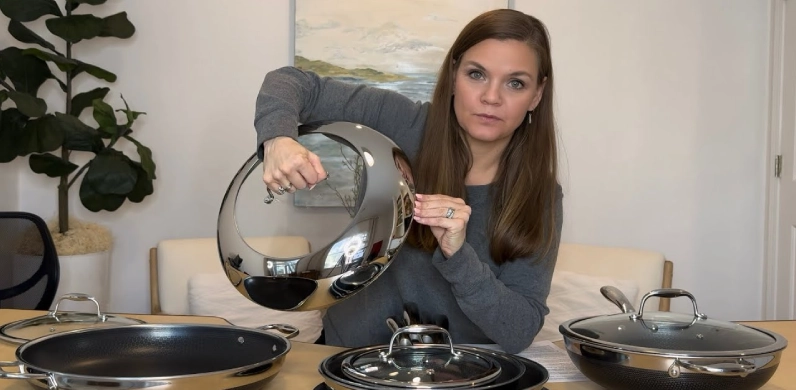
This is one of the few pans in its class that an independent testing organisation has actually put through a lab, which makes a review of it unusually easy to write honestly.
The results are good. The complaints people post are also real, and they mostly come from one skipped step. This HexClad 12 inch pan review covers both.
What the Lab Found
| What an independent lab reported | The result |
|---|---|
| Cooking evenness across the surface | Excellent |
| Releasing multiple eggs in succession | Very good |
| Surviving 2,000 strokes of steel wool | Excellent |
| Handle staying cool enough to hold | Excellent |
| The overall score and ranking | Behind a membership paywall |
Excellent at surviving 2,000 strokes of steel wool, which is the test that separates hybrid pans from ordinary nonstick.
An independent consumer testing organisation rated it excellent for cooking evenness across the whole surface, very good at releasing multiple eggs in succession, and excellent for handle temperature.
The headline result is abrasion. It was rated excellent at withstanding up to 2,000 strokes of steel wool, which is a deliberately brutal test and the one that matters most here.
That figure is the entire argument for hybrid cookware. An ordinary nonstick pan is a coating on metal, and steel wool destroys it. Here the surface is raised steel hexagons with nonstick in the valleys between them, so the steel takes the abuse.
One honest limit. The organisation’s overall score and its ranking against the other 43 nonstick pans it tested sit behind a membership paywall, so we can tell you the category grades and not the final position.
The Step That Causes the Bad Reviews
| The step people skip | What happens if you do |
|---|---|
| Season before first use | Food sticks and you blame the pan |
| A teaspoon of oil, medium low, 2 to 3 minutes | The valleys fill and release properly |
| Repeat occasionally, not just once | Performance stays where it started |
| Why a nonstick pan needs this at all | The surface is part steel, not all coating |
| What this makes it closest to | Carbon steel, with easier cleaning |
The maker tells you to season it. A teaspoon of oil, medium low heat, two to three minutes.
Search for complaints about this pan and nearly all of them say the same thing, which is that food stuck.
The instructions ask you to season it before first use with a teaspoon of oil on medium low heat for two or three minutes, and plenty of people treat that as optional because the word nonstick is on the box.
It is not optional, and the reason is structural rather than fussy. The cooking surface is part steel and part ceramic, so the steel ridges need what any steel pan needs, and the seasoning is what makes the whole surface behave as one.
The useful way to think about it is as carbon steel that cleans up easily rather than as Teflon that lasts longer. Treated that way it performs, and treated as a conventional nonstick pan it disappoints.
- Season before the first cook, not after the first failure
- Repeat the seasoning occasionally rather than once ever
- Preheat properly before adding food
- Use a little fat, as you would with stainless
- Do not judge it on a dry egg on day one
What You Get for the Money
| The 12 inch pan, in detail | What it is |
|---|---|
| Price | $148, reduced from $179 |
| Construction | Tri-ply with an aluminium core |
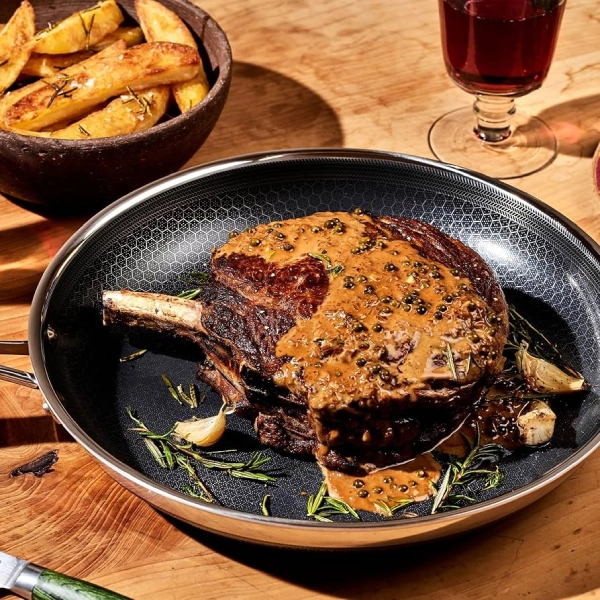
| Surface | Steel hexagons over ceramic nonstick valleys |
| Oven safe to | 900F |
| Dishwasher and metal utensils | Both allowed |
| Weight | 3.4 lb |
| Warranty | Lifetime against manufacturing defects |
Nine hundred degrees in the oven, metal utensils allowed and the dishwasher permitted, which no ceramic nonstick pan can offer.
The pan is $148 reduced from $179, built tri-ply with an aluminium core for heat distribution, weighing 3.4 pounds with a flat bottom of 11.4 inches.
The freedoms are the point. Oven safe to 900F, metal utensil safe and dishwasher safe is a combination no traditional nonstick surface survives. That is why a lifetime warranty against manufacturing defects reads as credible here rather than optimistic.
The coating in the valleys is a PFAS free ceramic, which puts this hybrid cookware in the same regulatory conversation as the ceramic brands without the same fragility.
Against a $30 supermarket nonstick pan this is expensive, and the honest comparison is not against that pan but against buying that pan four or five times.
Pan Only or Pan With Lid
| Option | Was | Now | Off |
|---|---|---|---|
| 12 inch fry pan, no lid | $179 | $148 | 17.3% |
| 12 inch fry pan with lid | $199 | $156 | 21.6% |
| The lid on its own, effectively | – | $8 | – |
| Lid oven rating | – | 400F | Pan is 900F |
The lid adds $8 and caps your oven temperature at 400F if you leave it on.
The pan alone is $148 and the version with a vented tempered glass lid is $156, so the lid costs eight dollars, which is the easiest eight dollars in this article.
The catch is worth knowing. The glass lid is rated to 400F while the pan is rated to 900F, so anything going into a hot oven goes in uncovered or with foil.
That is not a fault, it is simply what tempered glass does, and it only becomes a problem if you assume the lid shares the pan’s rating.
Who Should Buy
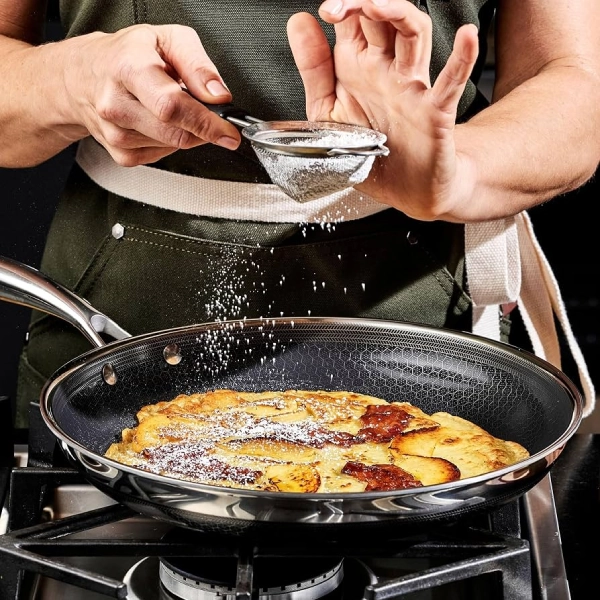
Buy if you want one pan for searing, frying and oven finishing, you are tired of replacing nonstick pans every couple of years, you will do the seasoning step, and a lifetime warranty matters to you.
Look elsewhere if you want a pan that releases a dry egg with no fat at all, or if you cook so rarely that a cheap nonstick pan will outlive your interest in it.
Final Verdict
| Category | Score |
|---|---|
| Independently Tested Performance | 9 / 10 |
| Abrasion Durability | 9 / 10 |
| Oven And Utensil Freedom | 9 / 10 |
| Nonstick Without Oil | 5 / 10 |
| Price Against Plain Nonstick | 5 / 10 |
| Overall Score | 8 / 10 |
Eight out of ten, and the independent testing is why. An external organisation rated it excellent for cooking evenness, very good at releasing eggs repeatedly, and excellent at surviving 2,000 strokes of steel wool, which is the result that justifies hybrid cookware existing. Oven safe to 900F with metal utensils and the dishwasher allowed, plus a lifetime warranty, is a genuinely rare combination. What holds it back is that it needs seasoning before it works properly, it is not a dry egg pan, the lid caps you at 400F, and $148 is several times a basic nonstick. Anyone reading a HexClad 12 inch pan review should season it before judging it.
FAQs
How much is the HexClad 12 inch pan?
$148 reduced from $179 for the pan alone, or $156 from $199 with a vented glass lid.
Does food stick to it?
Not once seasoned and used with a little fat. Most complaints come from skipping the seasoning step before first use.
How do I season it?
A teaspoon of oil in the pan on medium low heat for two to three minutes before first use, repeated occasionally afterwards.
Is it really dishwasher and metal utensil safe?
Yes to both, and an independent lab rated it excellent at withstanding up to 2,000 strokes of steel wool.
How hot can it go in the oven?
The pan is rated to 900F. The glass lid is only rated to 400F, so remove it for high heat.
Is it worth the price?
Against replacing a cheap nonstick pan every two years, probably. Against a pan you want to release dry eggs forever, no.
